 |
|
My Family and My House |
 |
|
Build your vocabulary! Click here to see vocabulary for the entire unit. |
|
5. A. Sue's family |
||
|
Yo soy Susana. Somos una familia de cinco personas. Hay tres hijos y dos padres. Yo tengo dos hermanos. | 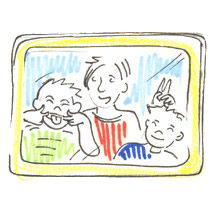 |
|
|
[Hija, Hermana, Yo, Mi]
Hija, Hermana, Yo, Mi. Can you figure out all of these words? Hija is daughter, hermana is sister, yo is I and mi is my.
You may have noticed by now that many words in Spanish have a gender (masculine or feminine) and a number (singular or plural). For example, hermano means brother and hermana means sister. To make them plural add an -s. What if it is a group of boys and girls? Then you would say hermanos! Yo tengo 12 años. Yo soy la hija mayor en la familia. También, soy la hermana mayor. [Padre, Él, Su] Mi padre es moreno. Él siempre está ocupado. Su nombre es José.
[Madre, Ella, Su]
Mi madre es rubia. Ella es baja y delgada. Su nombre es Ana. [Hijo, Hermano, Él, Su] Mi hermano es joven. Él tiene 9 años. Él es cómico y amigable. Su nombre es Miguel. Miguel es el hijo de mis padres. El es mi hermano pequeño/menor. Pequeño/menor are used the same way with the order one is born in the family. It is the same as saying My little brother vs. saying My younger brother. Just try to remember one of them but when you see the other, you can note it !
[Hija, Hermana, Ella, Su] Mi hermana es una bebé. Ella tiene 20 meses. Ella es muy activa. Su nombre es Alicia. Alicia es la otra hija de mis padres. Ella es mi hermana pequeña/menor. |
||


 |
||
|
5. B. More family |
||
| Mi perro, mis abuelos, mis tíos y mis primos | ||
|
Amigable is one word that does not show the gender (masculine or feminine). You can use it with both males and females without changing the ending! Another word like this is
mayor (older). On the other hand, you can see that divertido (fun) has several endings: -o, -a, -os, -as as with many adjectives in Spanish. What is an adjective exactly? It describes a noun! What is a noun? It is a word for a person, place or thing!
Mi abuelo es mayor. Él es muy divertido. Su casa está en Puerto Vallarta, México. Mi abuela es mayor también. Ella es divertida también. Ella vive en Puerto Vallarta con mi abuelo. Mi padre tiene una hermana. Ella es mi tía. Ella vive en Costa Rica. Ella está casada con mi tío. Ellos tienen dos hijos. Ellos son mis primos. |
||


 |
||
|
5 C. I have... |
||
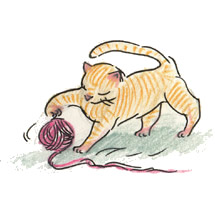
| Mascotas un perro (un gato, un pájaro, una serpiente, un hamster, un conejo, un pez). Yo tengo un perro pero no tengo un gato. Me gustaría tener un gato algún día. ¿Y a ti? ¿Te gustaría uno? |
 |
|
Mi mejor amigo tiene un gato. Su gato se llama Michi. Michi es tímido. ¿Es tu gato tímido? Compañeros de clase, maestros Yo tengo 11 compañeros de clase. ¿Cuántos tienes tú? Nosotros tenemos un maestro muy interesante y divertido. Su nombre es Sr.García. Nosotros tenemos otra maestra interesante, la Sra. Díaz. La directora de nuestra escuela es muy interesante también. Su nombre es Sra. López. A veces me meto en problemas, ¡como cuando traigo a mi perro Toby a la escuela!
Sr. is an abbreviation or shortened form for Señor. Is there something like this in English? Yes! Mister is shortened to Mr. . Can you find another word in the information above that is similar? Which one? Guess at its meaning!
Me meto en problemas means I get into trouble.
|
||


 |
||
|
5. D. Sue's house |
||
|
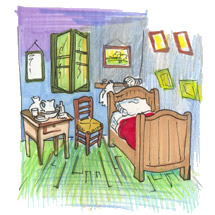
Mi casa es mediana, ni muy grande ni muy pequeña.
Mi casa tiene dos plantas - la planta baja y la primera planta. In many countries outside of the U.S., the ground floor is the floor in which you enter through the main door and the first floor up is called the first floor. You probably call the first floor up the second floor! |
 |
|
|
El
dormitorio de mis padres está
arriba. Es grande. Es verde.
Mi dormitorio está abajo. Es pequeño y rosado. Los dormitorios de mi hermano y de mi hermana menor están arriba también. Tenemos un baño. Está muy ocupado. If you are extra curious: There are several words for bedroom in Spanish. Just in case you have already seen another, you may realize you can also say un cuarto. In Mexico, people call their home bedrooms una récamara. In a hotel, a room is una habitación.
Arriba and abajo are opposites (upstairs and downstairs or in general, up and down). When your team is winning in a soccer game or does something well, you might scream ¡Arriba! |
||
|
Por la mañana
desayunamos en la
cocina en una
mesa pequeña.
Nos gusta leer el periódico en la mesa y hablar del mundo. Por la noche cenamos en la mesa del comedor. La mesa es grande y hay muchas sillas. Hay means there is or there are. |
||
|
¿ Jugamos adentro o jugamos afuera?
A veces vemos una película en el salón. Jugamos con juegos de mesa también. Mi padre nos lee en el sofá grande y marrón. Mi madre se sienta en una silla y teje. En invierno jugamos en el sótano. En verano jugamos en el garaje con nuestros amigos. Tenemos un coche azul en el garaje. A veces vamos al ático. ¡Qué miedo!
Jugamos al escondite. ¡Mi hermano pequeño es un gallina!
Nos gusta asustarlo. ¡No se lo digas a mi madre! Adentro vs. afuera. (Inside vs. outside.)
Gallina is a hen but here it means My little brother is a chicken! Is the Spanish similar or different to the English expression? Very similar!
Nos gusta asustarlo. ¡No se lo digas a mi madre! We like to scare him! Don't tell my mother! |
||
|
|
||
|
5. E. Things in a house or an apartment |
||
|
Mi amigo Mateo y su hermano Sergio viven en un apartamento con su familia.
Ellos comparten un dormitorio. Ellos tienen dos camas, dos lámparas y dos armarios en su dormitorio. En mi dormitorio yo tengo muchas cosas. Tengo una lámpara, un estante, carteles, libros y discos compactos. No tengo un televisor en mi cuarto. Hay una cama para mi perro Toby. Él es muy activo pero también le gusta dormir. Mi hermana pequeña tiene muchos juguetes. Ella tiene muñecas y peluches. Su favorito es su osito de peluche. Se llama Tedy. Es marrón y suave. Mi hermano pequeño tiene un despertador, una foto de sus amigos, un armario, una cama, un espejo y una almohada. Él tiene un tren y muchos coches de juguete. ¡Su dormitorio está muy desordenado! ¿Está tu cuarto desordenado también? ¿Qué tienes en tu dormitorio? |
||


Constructing New Meanings
Juggling Your New Knowledge

Culture Reading

Geography Reading

Writing activity

Web photos
You did very well. Go on to Unit 6. See you soon!
©2006 Tree Frog Publishing
Reproduction of this web site or its contents by any means is not permitted.