|
3. A. Days of the week
|
|
Días de entresemana
lunes martes miércoles jueves viernes
|
|
El fin de semana
sábado domingo
|
|
El primer día de la semana es
lunes.
In Spanish, the first day of the week is lunes (Monday), not Sunday as in English. Did you notice that the days of the week are not capitalized in Spanish?
|
|
|
¡Estoy muy ocupado(a)!
|
|
|
Toco el piano. El piano is a word that looks the same in English (called a cognate, or a friend), so you should use your sleuthing powers of deduction to guess what activity this is.
Ceno refers to eating the last meal of the day. If you are a curious sleuth, you may want to know this: to say you are eating meals you say: desayuno, almuerzo, ceno, in that order.
Meriendo is I have a snack. So, which one is breakfast? See below to find out!
|
|
|
|
|
|
Los sábados me gusta dormir hasta tarde.
Desayuno con mi familia. Veo dibujos animados en la tele.
Hasta tarde means until late.
|
|
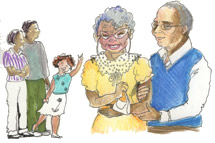
Los domingos también me levanto tarde. Leo el periódico con mi familia. Voy a la casa de mis abuelos. Los domingos mis padres
me dan la propina. A veces compro dulces.
Me dan la propina means they give me my allowance. Propina is also used for tip in a restaurant!
|
|
Los lunes me gusta levantarme tarde pero
no puedo.
Tengo que
ir al colegio.
Puedo means I can, tengo que means I have to.
|
|
¿Qué haces. . .
Esta semana, el martes, voy a ir a la biblioteca. Mi familia va a ir a casa de mi abuela. Mis amigos y yo no vamos a jugar.
El sábado y el domingo vamos a jugar al béisbol. |
 |
|
|
El miércoles, ¡vamos a jugar al fútbol!, ¿de acuerdo?
El jueves, ¡vamos al cine!, ¿de acuerdo?
El fútbol is a false cognate or false friend. It does not mean the same as in English! It means soccer. But, there are many true friends between English and Spanish so you should always use your powers of deduction and take a good guess.
Use ¿de acuerdo? at the end of a statement as you would "Okay?" in English.
|
|


 |
|
|
3. B. Numbers 1-31 and the date.
|
|
Hoy es miércoles, 9 (nueve) de agosto. Es el cumpleaños de mi madre. Vamos a ir a un restaurante. ¡Feliz cumpleaños, mamá!
El jueves, 2 (dos) de mayo, quiero ir a casa
de mi amigo a una fiesta pero no puedo. Tengo que
estudiar.
El 25 (veinticinco) de diciembre
muchas personas en el mundo celebran la Navidad. ¡Feliz Navidad!
|
|
El 1 ( primero) de enero muchas personas celebran el Año Nuevo. ¡Feliz Año Nuevo!
If you are curious about this, you use primero with the date, not the word uno.
|
|

|
|
|
3. C. Let's learn the rest of the months and the seasons
|
|
enero febrero marzo abril mayo junio julio agosto septiembre
octubre noviembre diciembre |
|
|
In the northern hemisphere where the U.S., Mexico, Spain and some of the other Spanish-speaking countries are...
|
 |
|
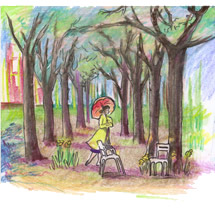
La primavera es en marzo, abril y mayo.
¿Cuál es el color de la primavera? - Verde para el césped. |
|
El verano es en junio, julio y agosto.
¿Cuál es el color del verano? -Azul para el agua. |
|
El otoño es en septiembre, octubre y noviembre.
¿Cuál es el color del otoño? -
Anaranjado para las calabazas.
|
|
El invierno es en diciembre, enero y febrero.
¿Cuál es el color del invierno? -Blanco para la nieve.
|
|
|
Did you know that there are Spanish-speaking countries in the southern hemisphere?
|
|

|
|
|
3. D. The colors.
|
|
|
Rojo,
verde,
azul
, amarillo,
anaranjado,
rosado
, morado,
marrón,
blanco
,negro |
|
|
¿Cuál es tu color preferido?
Mi color preferido es azul.
|
|
¿Cuál es el color preferido de tu madre?
Su color preferido es rojo.
|
|
¿Cuál es el color preferido de tu padre?
Su color preferido es verde.
¿Cuáles son los colores de las banderas de los EE.UU., del Reino Unido, de Australia y de Nueva Zelanda?
-Rojo, blanco y azul.
¿Y de Canadá?
-Rojo y blanco.
|
|


|
|
|
3. E. What time is it? Telling the time of day
|
| Perdone, ¿qué hora es? |
-Son las 7:15 (siete y quince) de la mañana.
¡Hora de desayunar! |
|
| Perdone, ¿qué hora es? |
-Son las 2:00 (dos) .
¡Hora de almorzar! |
|
| Perdone, ¿qué hora es? |
-Son las 5:00 (cinco) de la tarde.
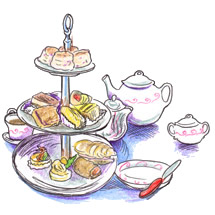
¡Hora de merendar!
|
|
| Perdone, ¿qué hora es? |
-Son las 9:00 (nueve) de la noche.
¡Hora de cenar! |
|
| Perdone, ¿qué hora es? |
-Son las 10:30 (diez y media).
¡Hora de acostarme!
|
Yikes! You may notice that people eat dinner rather late in some Spanish-speaking countries! |
|
|
When someone asks for the time, you say...
|
 |
|
|
There are other ways to give the time at some parts of the day. Some people say:
|
|
|
Mediodía and medianoche are 12 hours apart! Can you figure out what they mean?
|
|


|
|
|
3. F. To say when something happens
|
|
A las 7:15 (siete y quince) de la mañana desayuno.
A las 2:00 (dos) almuerzo.
A las 5:00 (cinco) de la tarde merendamos.
A las 9:00 (nueve) de la noche mi familia cena.
|
A las 10:30 (diez y media) de la noche vamos a acostarnos.
Acostarse is the opposite of levantarse which you saw at the beginning of this lesson. Have you guessed at the meaning? If you guessed to go to bed and to get up, you were right!
|