Abroad
 |
|
|
Unidad 11: En el extranjero
|
|

|
|
|
Build your vocabulary! Click here to see vocabulary for the entire unit.
|
|
|
11. A. Making travel plans.
|
||
|
My friend Peter will be coming to Spain with his family in June.
He asked me to help him with some of his travel vocabulary. I told
him to study everything he had already learned in his Spanish classes
but to keep in mind cultural differences. I told him to have
an open mind and the experience will be much more fun!
|
||
|
My name is Peter. My family would like to take a vacation Spain in June.
There are 5 of us: my mother, my father, my brother, my sister and me.
|
||
En primer lugar, necesitamos conseguir las fotos para nuestros pasaportes. En segundo lugar, necesitamos solicitar nuestros pasaportes. En tercer lugar, necesitamos comprar una guía de viajes y leer todo sobre Europa. Queremos visitar Madrid , Barcelona y Mallorca. |
||
|
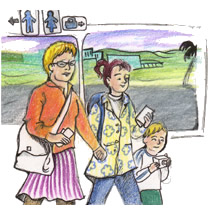
Billetes is used in Spain but boletos is used in many other countries
|  |
|
| En quinto lugar, necesitamos hacer nuestras reservaciones de hotel. | ||
| Luego, ¡necesitamos empezar a practicar español! | ||


 |
||
|
11. B. Making reservations
|
||
| Mi amiga en España, Pilar, me dijo que hiciera reservas por adelantado. | ||
|
On the telephone
|
||
|
Hola. Me gustaría reservar dos
habitaciones de hotel para cinco noches. ¿Tiene una habitación con vista a la ciudad? |
||
|
¿En qué piso está? ¿Hay un ascensor? ¿Cuánto es por noche? ¿Aceptan Uds. tarjetas de crédito? Le enviaré un fax con mi petición también. Por favor, confirme mi reservación con un fax. ¡Gracias!
Piso (used in Spain) is the same as planta depending on the country. Piso also means apartment or flat in Spain.
Ascensor (used in Spain) is the same as elevador.
|
||
|
|
||
11. C. In June in the hotel
| ||
|
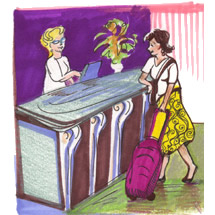
¿Tiene buenas vistas? ¿Hay transporte público cerca? |
 |
|
-Sí, afuera vayan Uds. derecho. A una manzana de aquí hay una estación de metro. También, delante del hotel, hay una parada de taxis. Pidan Uds. por el primer taxi de la fila. Si Uds. quieren un taxi que los lleve al centro de la ciudad, hagan una señal con el brazo en alto en cuanto vean a uno venir.
Uds. means "you all" for example here when a family
is being spoken to. It is formal. In Spain, it is very common to
be addressed in a group as vosotros, especially when amongst
friends or people your age. Here, the group is being told what to
do so the verb form is a bit different from what you have seen previously.
You may have noted that in the last lesson, you saw these commends
in the informal
Hagan Uds. una señal con el brazo en alto=Make a sign by lifting your arm high. Waving down a taxi is similar in many countries, however, in most large European cities you may only catch a cab at a cabstand (una parada de taxis). What is a cabstand? It is a group of taxis on a street corner who wait for passengers by taking turns. Cabs vary in color from country to country but unlike the U.S., in most countries covered on this web site, cabs are regulated by the government and must be all the same color. |
||
| ¿De qué color son los taxis aquí? | ||
-Normalmente son blancos con una línea azul y todos tienen una señal arriba que dice "taxi". Miren Uds. si la luz de la señal está encendida o no. Si está encendida el taxi está " libre" o si no, "ocupado".
Los taxis son blancos con una línea azul. In Spain taxis are many times white with a blue line. In Mexico, the taxis always used to be small, green Volkswagon Beetles! But now, they are doing away with them and replacing them.
Libre is the opposite of ocupado (available/free vs. busy/taken). |
||
|
Tenemos ropa sucia. ¿Tienen
servicio de lavandería? |
||
|
Perdone. Hay un problema con el cuarto de baño (el televisor, el teléfono, el secador, la puerta). ¿Puede arreglarlo? -Por supuesto. Alguien estará allí en un momento. |
||
|
Más = more
|
||
|
Quisiéramos pedir servicio de habitación. Quisiéramos un bistec, poco hecho (medio hecho, normal, muy hecho). Mi madre quisiera la sopa y una ensalada. Mi padre quisiera el pollo y para mi hermana y hermano, una pizza. -Perfecto. Estará preparado en treinta minutos. |
||
11. D. At the Front/Concierge's desk
|
||
| Perdone. ¿Dónde está la oficina de correos más cercana? Necesito comprar sellos. -Hay una oficina de correos en el centro de la ciudad pero está lejos de aquí. Uds. pueden comprar sellos también en tiendas más pequeñas donde se venden postales. ¿Podemos comprar recuerdos cerca del hotel también? -Sí, hay muchas tiendas. Doblen Uds. la esquina a la derecha y hay una calle larga con tiendas. ¿Podremos cambiar dinero allí también? -Sí, o pueden cambiarlo aquí en el hotel. Pero el cambio es mejor en el banco. Los bancos aquí abren de 8:30 de la mañana a 2:30 de la tarde. Hay también oficinas de cambio pero el cambio no es muy bueno. Si Uds. tienen una tarjeta de crédito o de débito pueden usarla en un cajero automático. ¿Un qué? |
||
|
El Corte Inglés is the most popular as well as fancy department store in Spain. They sell everything from drug store products to school supplies to batteries to souvenirs to beautiful clothing. They even have a post office, grocery store, travel agency, a hardware store and appliances in most stores!
Most large Spanish-speaking cities have at least one department store like this. It is a good way to get to learn a bit more about the culture. But you will also note that retail is not a social activity in Spanish-speaking countries. Shopping is a necessity, not really an activity. People like to shop but they spend more time with their families eating large meals, strolling in the parks, going to museums, etc. |
||
| Muchas gracias. -¡Que tengan un buen día! |
||
11. E. More shops and helpful things
|
||
|
¿Dónde está. ...la zapatería, la tintorería, la tienda de fotos, la óptica, el dentista, la lavandería, la agencia de viajes, el cibercafé, la oficina de turismo? ¿Dónde está el buzón? ¿De qué color es? -Es azul oscuro o verde oscuro, aunque los hay de otros colores también. ¿Puede Ud. ayudarme a enviar un fax? Dónde puedo conseguir. una tarjeta telefónica, un billete de autobús/de tren, una entrada, una reservación para... |
||
|
11. F. Travel troubles
|
||
|
Estoy perdido/a.
Por favor, ayúdeme.
Perdí. mi mapa, llave, cartera, tarjeta de crédito, pasaporte. ¿Puede Ud. ayudarme a hacer una llamada? Por favor, llame a la policía en mi lugar. Por favor, llame a una ambulancia en mi lugar. Por favor, pida a un taxi para llevarme al hospital más cercano.
Estoy perdido(a). Parents: please go to our travel tip
site and print a card with "I am lost" information for your younger
family members to carry with them when traveling.
Because these are all important expressions, this information is also included for you to print. In an emergency, if you cannot pronounce it, just point to it! |  |
|

Constructing New Meanings

Juggling Your New Knowledge

Culture Reading
Geography Reading

Writing activity

Web photos
You did very well. Go on to Unit 12. See you soon!
©2006 Tree Frog Publishing
Reproduction of this web site or its contents by any means is not permitted.