|
7. A. Shopping for My Family. Names of stores and places.
|
|
Excuse me, how do you say. in English?
|
|
|
|
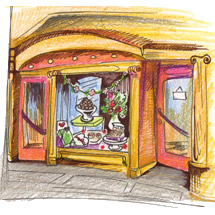
Shop, department store, shoe store, small grocery, fruit shop, butcher shop, bakery, bread shop, large supermarket, pharmacy, a paper store, toy store, book store, music store, sporting goods store, children's store, women's clothing store, men's clothing store, post office, candy/chocolate store
|
 |
|
|
|
What is...?
Is there a...?
Where is a...?
|
|
What is a department store?
-It is a large store that sells many things. They sell clothing, books, toys, and sometimes, even food.
Is there a department store nearby?
-Yes, for example, there is one on Main Street. It is right over there.
Thank you!
What is a grocery store?
-It is a store that sells many kinds of food.
What is a pharmacy ?
-It is a place where drugs and medicine are sold.
In the U.K., this may be called the Chemist.
|
|
|
What is a post office?
|
-It is a place where they sell stamps.
Is it far away?
-Yes, it is a little far. You should take a bus or taxi.
But near here they sell stamps on the corner.
-Thank you.
|
|


|
|
|
|
|
|
|
|
|
In the post office.
|
|
I would like to buy some stamps. How much do they cost?
-One stamp costs thirty-nine cents.
How many would you like?
Three please. And for postcards?
-One stamp for a post card is only thirty cents.
I would like two please.
In the U.K. you would buy a stamp for
about 30 pence. In Australia, a stamp is about 50 cents.
|
|
|
In the butcher shop.
|
My mother needs two
pounds of this meat here.
How much is it?
-It is six dollars per pound. That will be twelve dollars, please.
In the U.S.A., you would purchase meat by the pound
but in Australia by the kilo (on the metric system).
In the U.K., the currency is the pound, not to be
confused with the weight pound.
|
|
|
In the fruit shop.
|
|
My father needs five oranges.
How much are they?
-They are thirty cents each. That will be one dollar and fifty cents, please.
Here is a ten dollar bill.
-Do you have change?
No sorry, I don't.
-Okay, here is eight dollars and fifty cents in change.
In the U.K., this
would be one pound and fifty pence, or as
is commonly spoken, one pound fifty.
In the U.K. a ten
dollar bill (U.S.A.) would be called a ten pound
note.
|
 |
|
|
In the bakery.
|
|
I would like two of these in the front of to the, a display case please.
How much are they?
-They are sixty cents each. That will be one dollar and twenty cents.
You will notice that in English there are many words to point
things out that you do not know how to say: this, that,
these, those and other general words to represent objects
like one or some. Unlike many languages, there is no gender
in English so don't worry about getting it right. It's easy!
|
|
|
7. C. Buying things you need
|
|
|
In Australia and the
U.K., a cell phone is called a mobile phone.
No way! is
what you say when you completely disagree with something or
don't believe it.
|
|
|
|
|
| |
|


|
|
|
7. D. Describing what you are looking for, Asking questions
|
|
Shapes - a square, a rectangle, a circle, a triangle
Sizes - long, short, big, small
In a big department store.
|
|
-May I help you?
Yes, please. I would like to buy something for my brother. I speak some English but sometimes I forget how to say some words. It is a rectangle and it is made of paper.
It has two pockets for papers.
-You need a folder.
Oh, yes a folder.
Thank you. How much is it?
-It is seventy cents.
I also need a gift for my mom for the kitchen. They are round and made of ceramic. They are for eating food.
-You need plates.
Yes, six plates. Are they nearby?
-Yes, they are over there on the left.
I like the smaller ones better. Do they come in white?
I need something to carry my books and papers to school. It is big
and usually square.
-You mean a backpack?
Yes, that's right, a backpack. Do you have any?
-Yes, we have a blue one or a red one.
Thank you. I like the red one better.
I would like to buy a gift for my father but I don't know the word in English. It is long and he wears it on his neck.
-Oh, a tie.
Yes, a tie. How much is it?
-It is thirty dollars.
Do you have a cheaper one?
-Yes, here is one for twenty dollars.
Hmm.I like the other one better. Can you wrap it?
|
|
|
|
|
|
|
|
7. E. The Market, Being polite, Bargaining
|
|
|
|
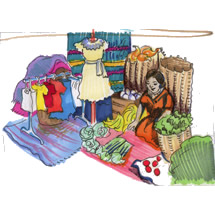
In some countries you can go to a market everyday where they sell everything. In other countries, you can go maybe only once per week where they sell used things. Sometimes, you can bargain to buy an item you like but want to pay less for.
Markets are not as common in the U.S. as in some countries but on weekends you almost always find flea markets (organized sales of used items and antiques) or garage sales at people's homes when the weather is nice.
|
 |
|
|
In the U.S.A., the expressions pardon me and excuse
me are used equally when trying to get someone's attention,
when interrupting someone who is speaking, when you want someone
to repeat something said and also when you bump into someone.
|
 |
|
I would like to buy this but I don't remember the word.
-That is a watch. Would you like to buy it?
Yes, I like the round one but how much is it?
-For you, only forty-five dollars.
Oh, that is too expensive. Do you have something cheaper?
Yes, this square one. But if you really like the round one, you can have it for thirty.
|